
By: Kendall Upton

Chris Hedlund
Updated: January 14, 2026

By: Kendall Upton
Chris Hedlund
Updated: January 14, 2026
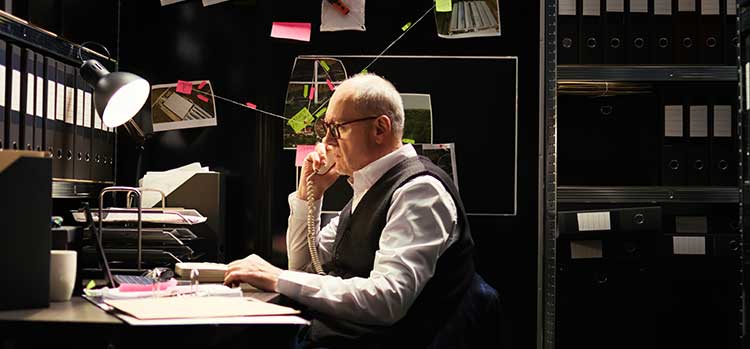
One of many roles working behind the scenes at law enforcement agencies is the scrupulous professionals that handle evidence brought in from crime scenes. Known as property and evidence custodians, these individuals are vital to a law enforcement agency’s ability to properly manage their evidence, which in turn affects the agency’s investigative efficiency.
The requirements to become a property and evidence custodian vary by agency, so it’s important to understand what this role entails to determine the best educational and professional path forward for you.
In this Article
Property and evidence custodians—who may have similar titles such as property and evidence technicians—receive, store and track property and evidence that has been collected by law enforcement personnel.
Local, state and federal law enforcement agencies all employ property and evidence custodians, but that doesn’t mean they’re all law enforcement officers themselves. Many are civilian employees, but it’s also fairly common for law enforcement officers to become property and evidence custodians because their experience is relevant to the role.
Property and evidence custodians manage the property and evidence rooms at law enforcement agencies. Law enforcement personnel and crime scene investigators bring them evidence items—anything from a bloodstained glove to a stolen vehicle—to store for safekeeping. These items must be meticulously inventoried by the custodian so that the chain of custody remains intact and items aren’t lost, mixed up or damaged, which could compromise a criminal case. Though it may not be as fast-paced as other law enforcement jobs, property and evidence custodians are essential members of the law enforcement system.
The primary job responsibilities of property and evidence custodians include:
“A facet of our job that many other agencies have is crime scene call out, where we actually respond to crime scenes and process crime scenes with our investigation team. Not all evidence technicians get to do that, but we are trained to do that. We do photography, we do evidence collection—be it clothing, swabs of blood, things like that—and then we process those through our evidence records management system to maintain the chain of custody. Then we also package it, bring it back to the station and put it in our property room,” said Chris Hedlund, Evidence Technician Lead for the Tukwila Police Department in Tukwila, Washington.
Though not every property and evidence custodian actually processes evidence at crime scenes, all of them perform property and evidence intake daily.
“Our day to day is management of property, so we are accepting and maintaining any evidence or safekeeping property that officers are bringing in from their cases. That can be something as simple as a backpack from somebody they arrested that we would give back or destroy within 60 days, or it can be as complex as a firearm that was used in a homicide.”
Property and evidence custodians also have to do a fair amount of research.
“We’re constantly working with the public to get them their property back, and a lot of times that could be property that was used in a crime that we’re not legally allowed to give back until the case is adjudicated through the court. Is this person legally allowed to have a firearm or are they barred? There’s a lot of investigative research in terms of background checks on people for firearms,” Hedlund said.
Maintaining the property and evidence room also requires getting rid of items they don’t need anymore to make space for new evidence. This can be a challenge when, for example, they are legally obligated to keep items from unsolved homicide, rape or sexual assault cases indefinitely. They have to follow up on cases to determine whether the affiliated evidence must be kept or not.
Some of Hedlund’s favorite parts of her job are the things she does that aren’t necessarily in her job description. Crime scene processing, for example, may be performed by dedicated crime scene units at other agencies, but she loves to do it where she works.
Hedlund said she and the other evidence technician she works with also help out their agency’s cold case investigator. She’ll pull old case files, they’ll read them together and then she can work with the crime lab to determine what kind of forensic testing has already been done and what else they could do.
Every law enforcement agency determines the minimum qualifications for property and evidence custodians. Some only require that they have a high school diploma or GED and a valid driver’s license, while others may only accept applicants with several years of experience in the role, those with prior law enforcement experience or those who have a property and evidence certification.
Though it may not be explicitly required, earning an associate or bachelor’s degree in a relevant area such as criminal justice, criminology, forensic science or something similar could help make you a more competitive job candidate, especially if you don’t already have some experience in the field.
People that want to become property and evidence custodians may also want to consider taking a training course, workshop or seminar to get even more experience and exposure to the job. The Washington State Criminal Justice Training Commission, for example, has a weeklong property and evidence room management course for criminal justice professionals. The International Association for Property and Evidence (IAPE) also offers live and online classes. While training courses can certainly be helpful, Hedlund said that many evidence technician jobs provide on-the-job training for those who don’t already have experience.
Several professional organizations offer certifications for property and evidence custodians. Though completely voluntary, some employers may require their property and evidence custodians to have a certification, so it’s a worthwhile credential to work towards in your career.
Property and evidence custodians can become a Certified Property & Evidence Specialist (CPES) or a Corporate Certified Property & Evidence Specialist (CCPES) through the IAPE. The only difference between the two certifications is that the CPES designation is for law enforcement agency professionals, whereas the CCPES is for non-law enforcement corporations and companies. The requirements for both are as follows:
The Evidence Management Institute (EMI) also offers a certification for those who complete their training course and pass their certification exam.
Anyone thinking about a career as a property and evidence custodian should have a firm understanding of what the job is really like before diving in—that includes the good, the bad and the ugly.
“The hardest part would be, you know, processing a crime scene with a family standing nearby where their son, daughter or parent is deceased, or even just meeting up with a family after the fact and giving them back their loved one’s belongings is a really devastating experience,” Hedlund said.
Though interacting with grieving families isn’t anything new for Hedlund who also has prior experience as an embalmer, it’s still an emotionally taxing aspect of what she does.
“It’s so raw when it just happened and [the family] is just getting secondhand information that their son/mother/father/brother was shot and killed. It’s just hard to see people on the worst day of their life and where you don’t have anything to say except ‘I’m sorry.’”
If you want to succeed in this role, Hedlund said there are a few vital skills you’ll need to have.
“If you don’t have attention to detail, it can be catastrophic for a property room,” Hedlund said. “You can’t make new evidence, so if you use up that DNA evidence on the wrong test, then you might have just sunk a case. So you have to be very, very cognizant of what you’re doing with the evidence and making sure that you’re not breaking chain of custody, because that can also throw an entire case out in court.”
Since the day-to-day routine of a property and evidence technician can change at a moment’s notice, Hedlund said you also need to be flexible and adapt to each new situation as it arises.
“You really have to be able to multitask, and you have to be okay with your day changing in five seconds. You never plan when a crime scene is going to happen. Along with multitasking, you really have to be good at time management because you do have to get a lot of things done in a short amount of time. You might have to process 200 items of evidence, so you can spend 10 hours or more on a crime scene and know that you still need to write a report or do a report by tomorrow.”
Unfortunately, the U.S. Bureau of Labor Statistics (BLS) doesn’t track salary data for property and evidence custodians specifically. The closest job category would be forensic science technicians, which have a median annual salary of $67,440, or police and sheriff’s patrol officers who earn $76,290 annually.
Property and evidence custodians may be able to earn more with more experience over time by eventually moving into lead roles where they oversee and manage all the property and evidence custodians in an agency.
Property and evidence custodians are integral members of law enforcement operations everywhere, safeguarding precious evidence to ensure that it’s stored properly so that it may be used to solve crimes. Requirements can vary to get into this line of work, with some agencies requiring minimal education and others preferring relevant law enforcement experience. Whether or not it’s required, most people should also consider earning a college degree to up their value in the job market and develop the crucial skills needed for the job. Use our Find Schools button to see what kinds of programs could set you up for a rewarding career as a property and evidence custodian.